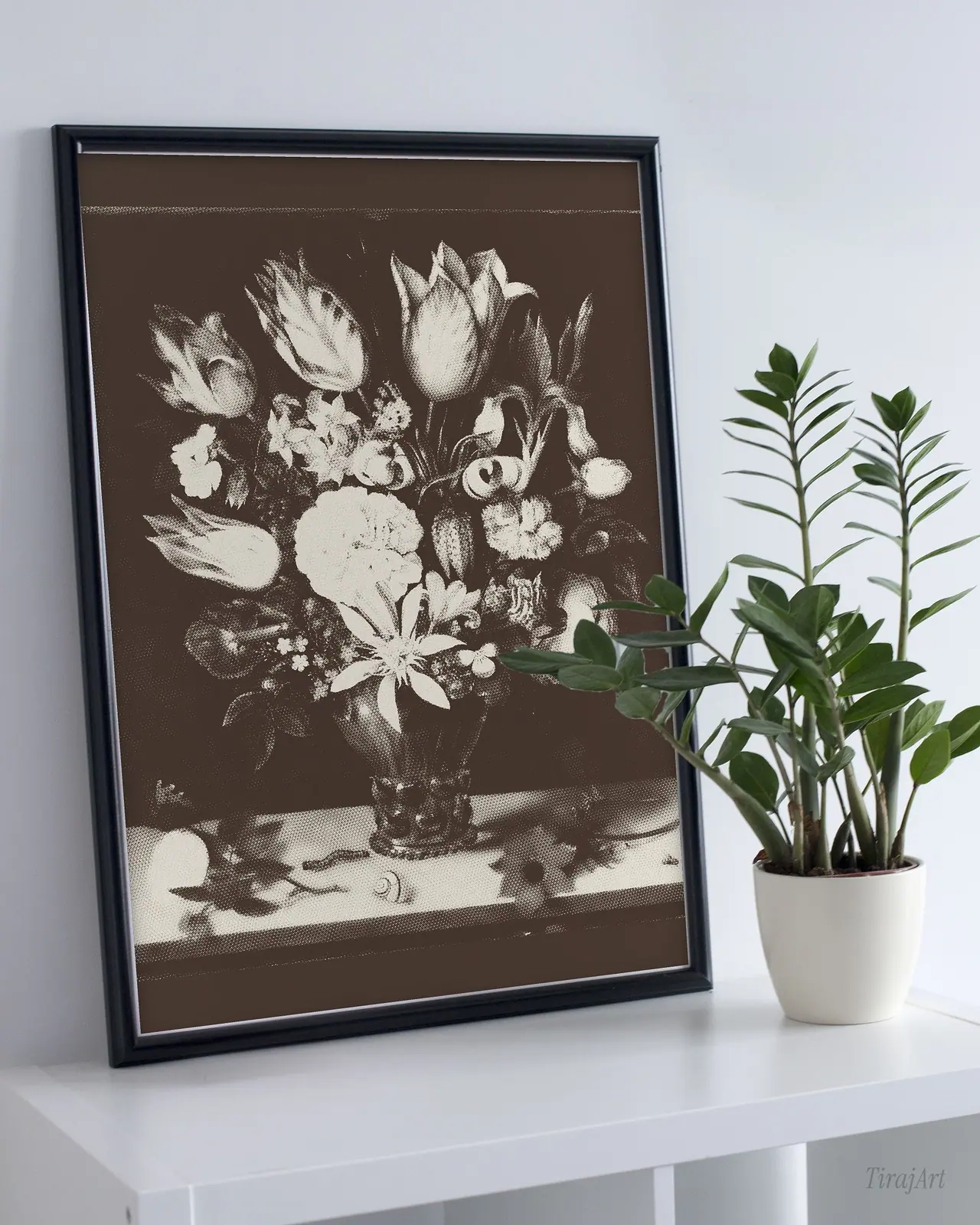
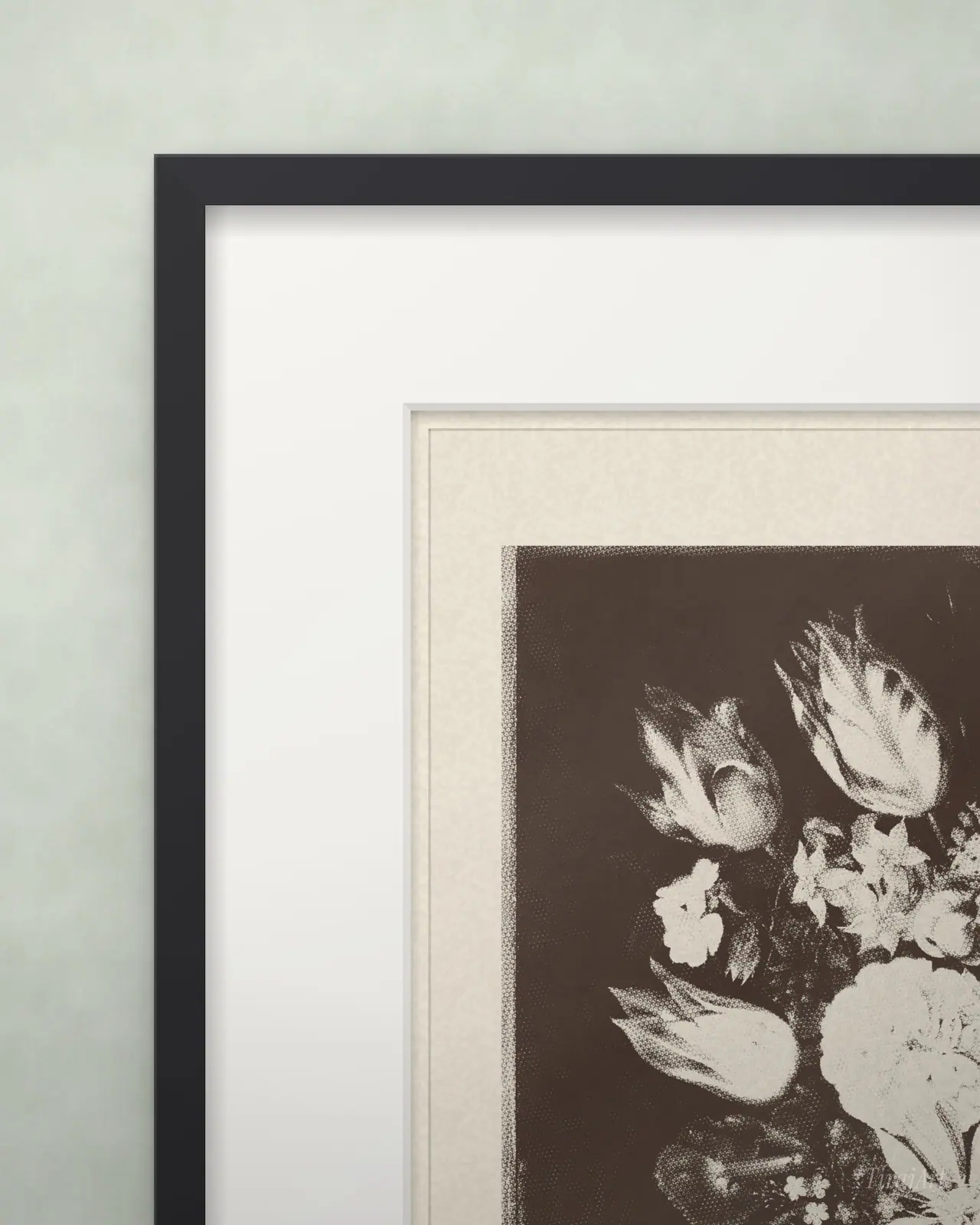
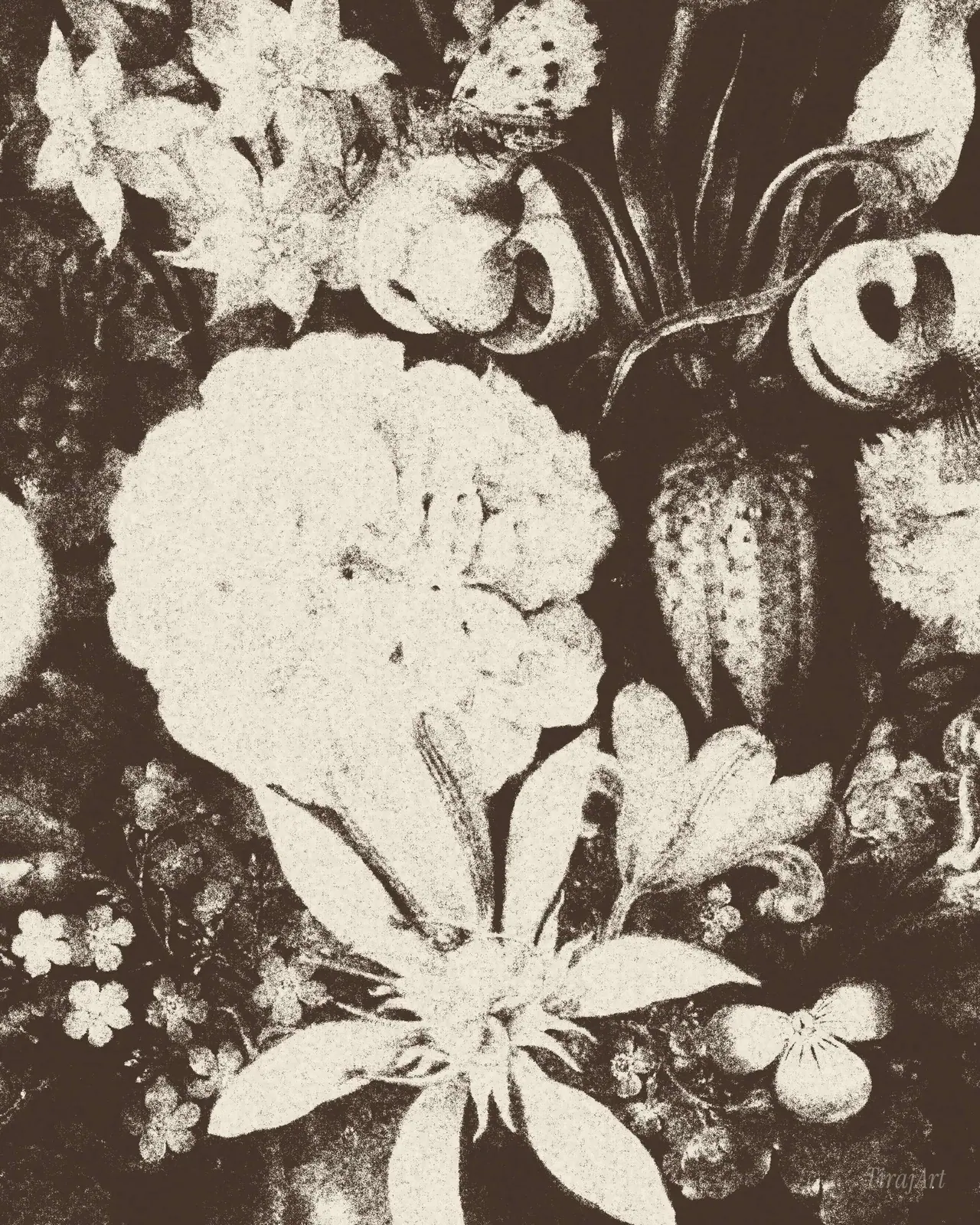
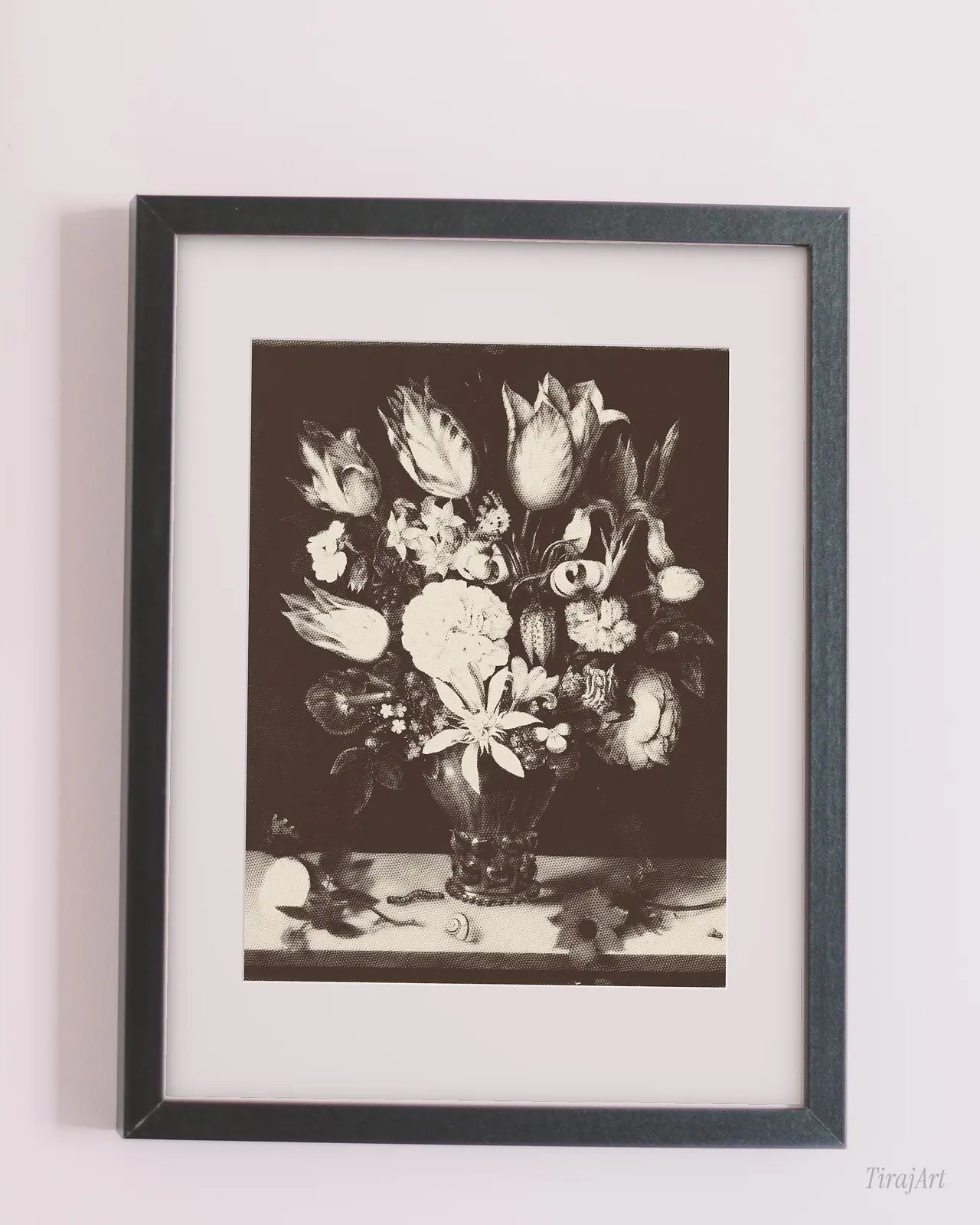
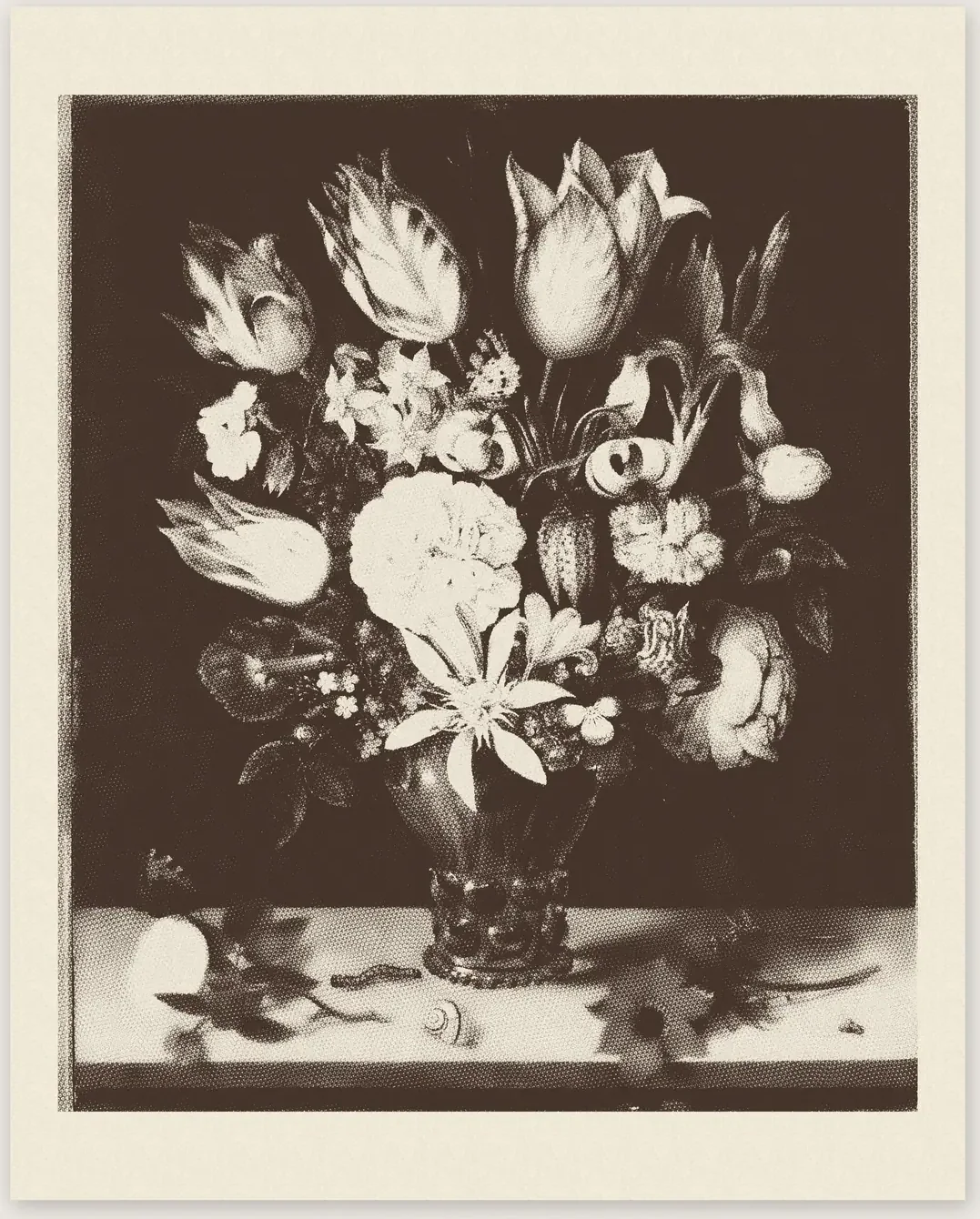
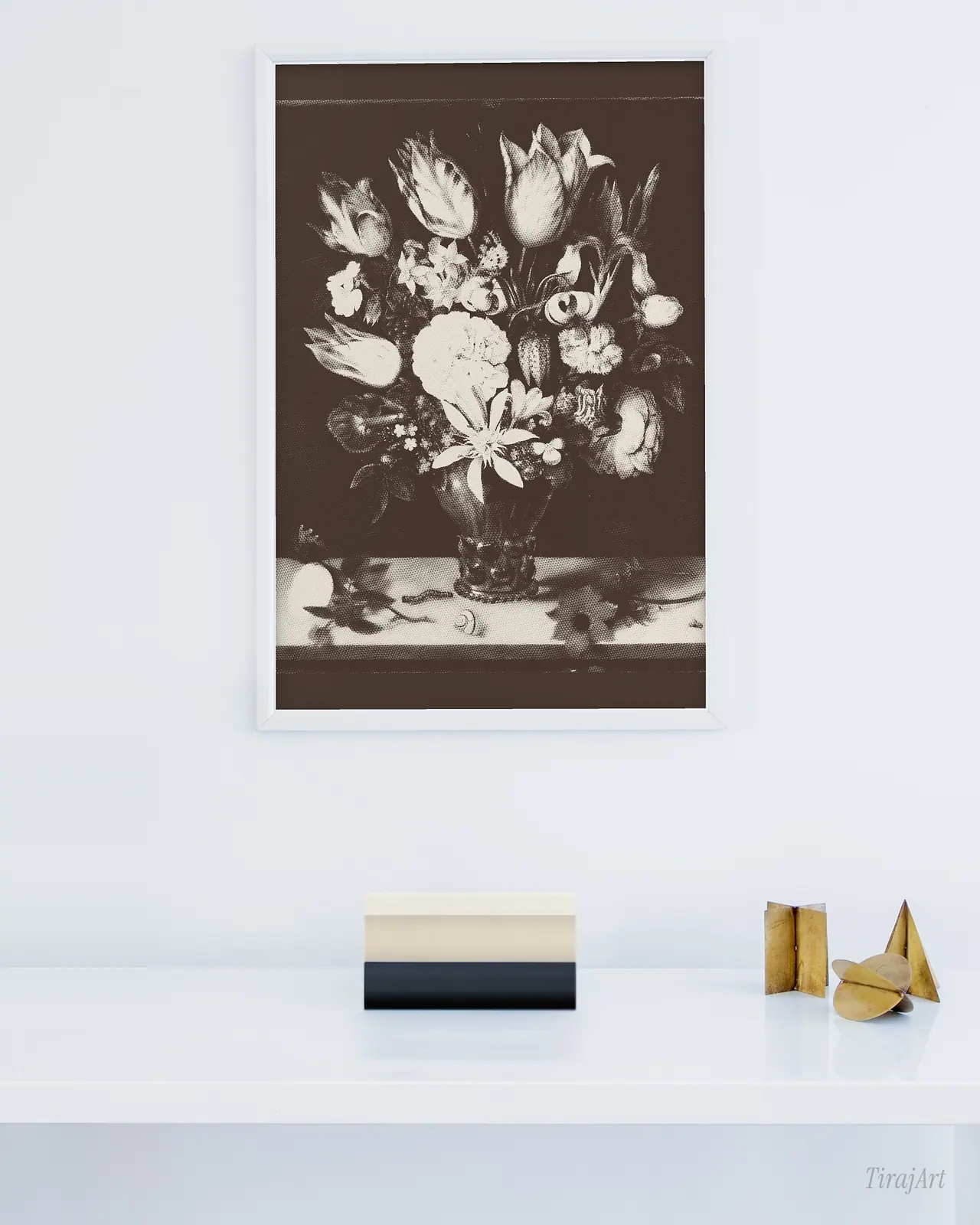
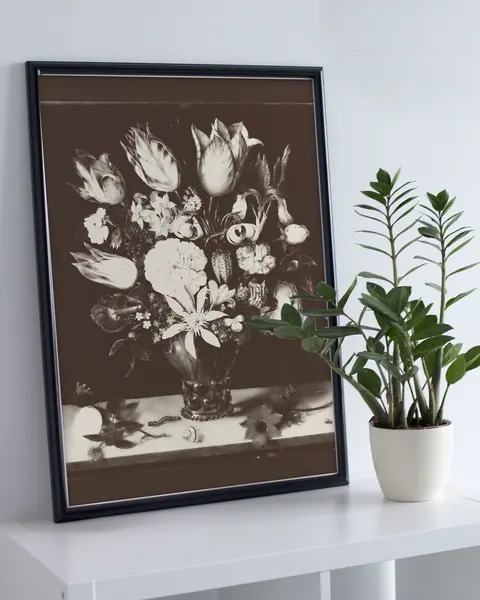
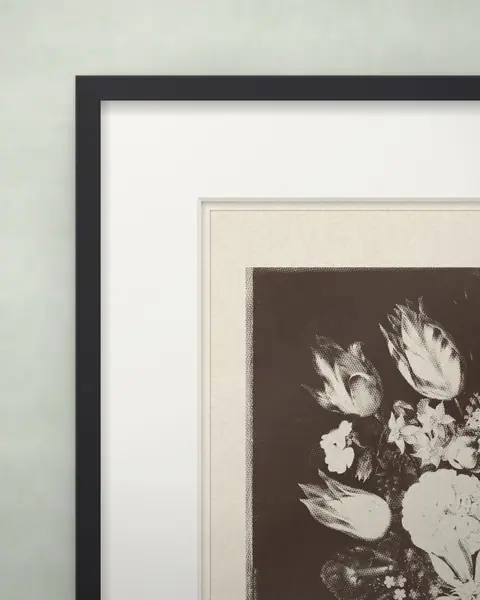
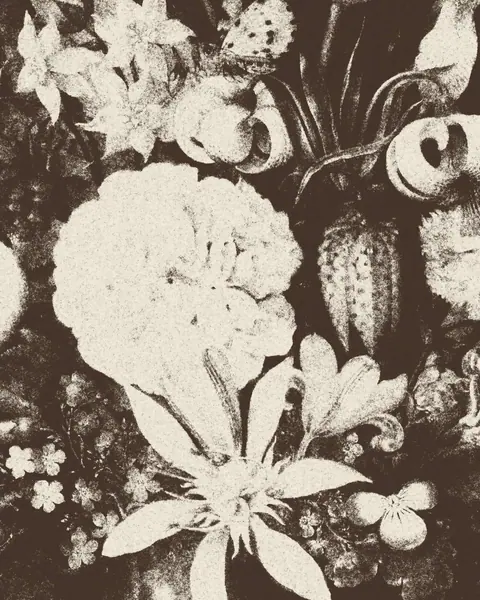
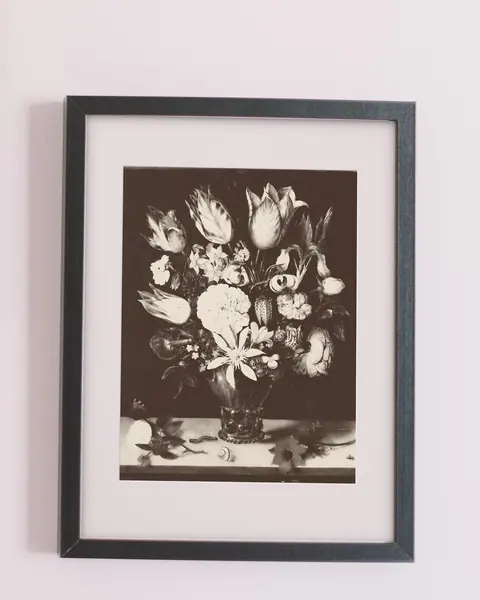
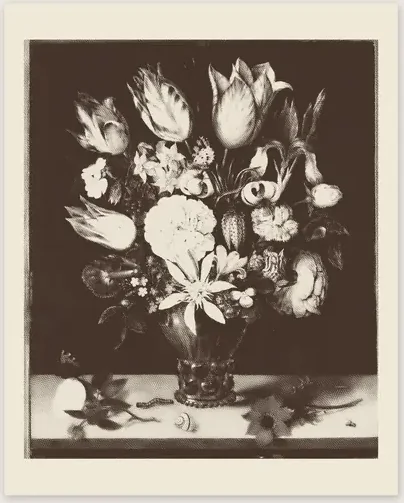
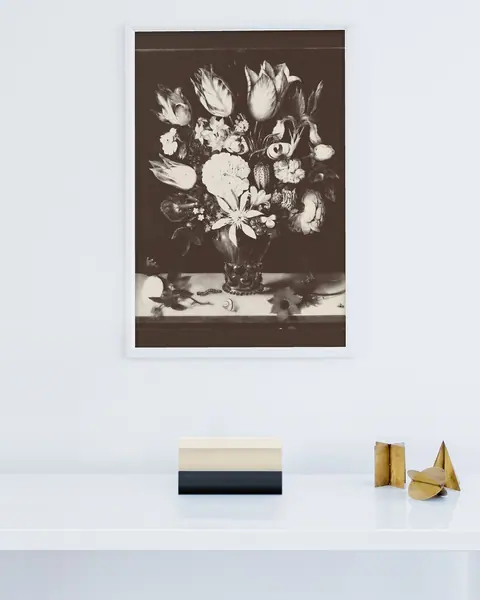
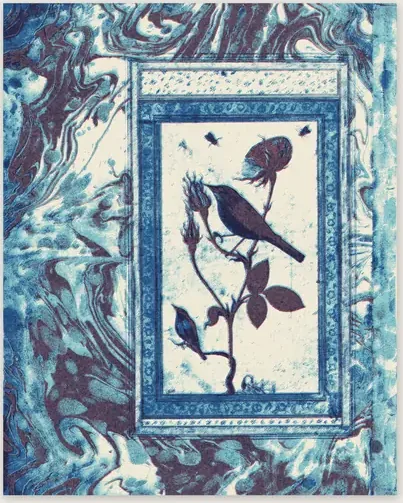
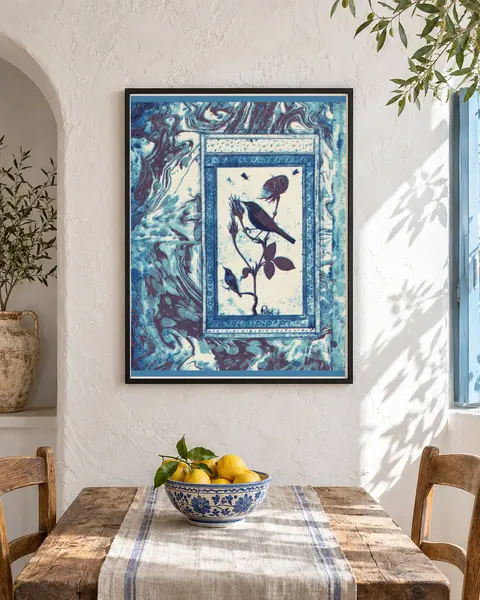
Ambrosius Bosschaert's 1606 bouquet of tulips, roses and irises in a glass, reprinted as a mezzotint in bistre brown on warm cream paper: the flowers glow out of a velvet dark.
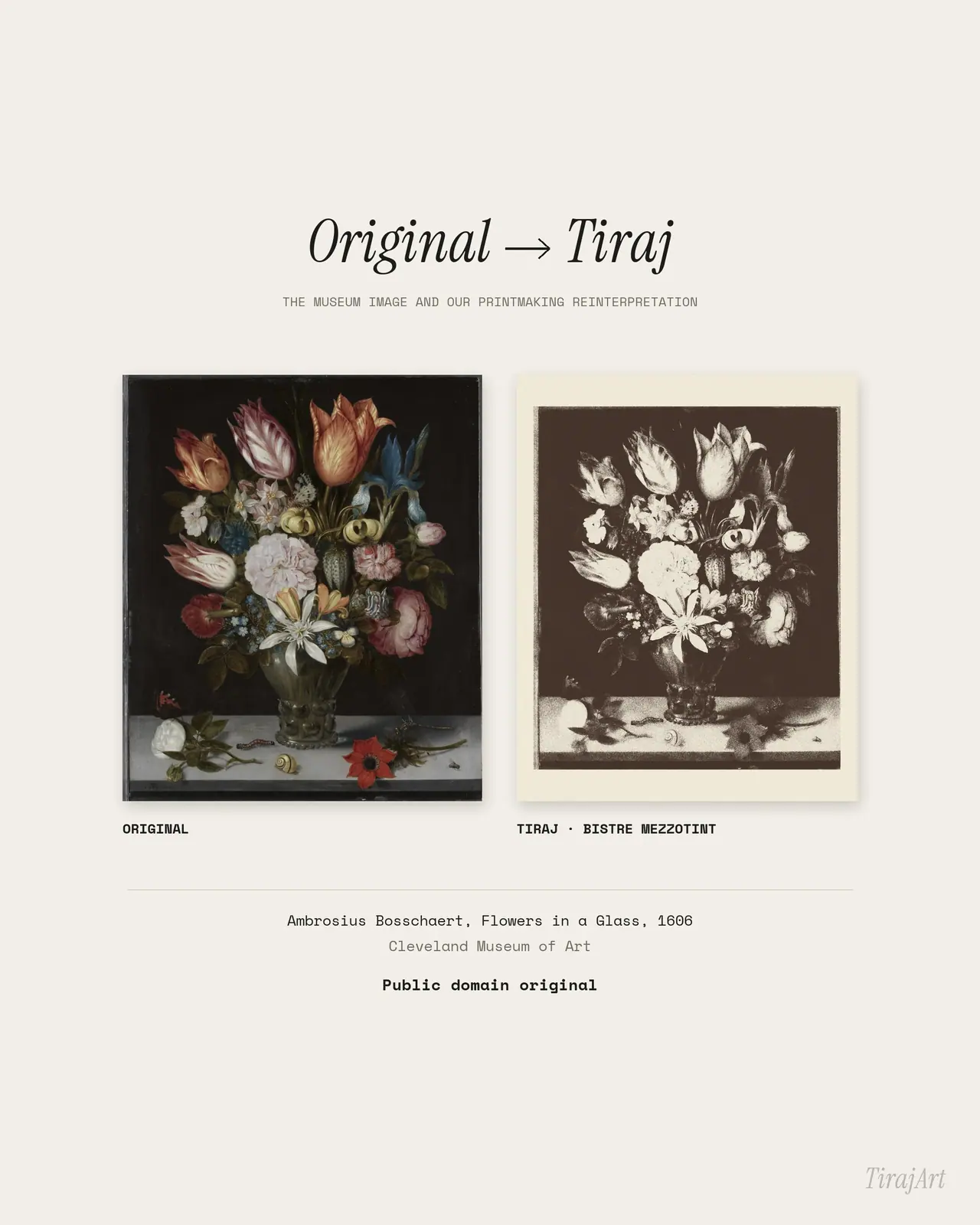
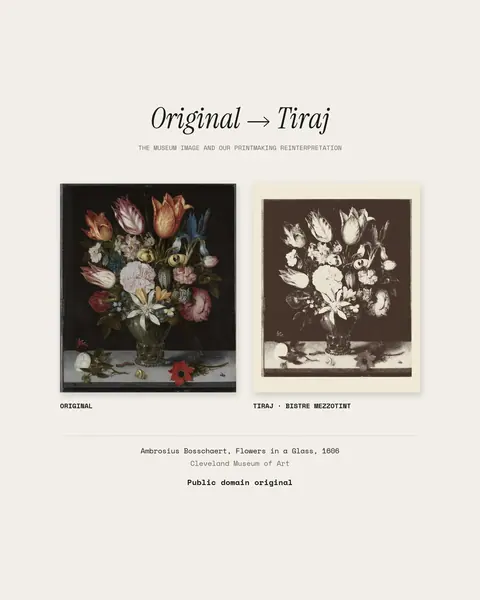
The original
“Flowers in a Glass” by Ambrosius Bosschaert (Dutch, 1573–1621), 1606, is in the public domain. The image comes from the Cleveland Museum of Art, which shares it under CC0 (no rights reserved).
The print
Tiraj reinterprets the painting as a mezzotint: a rocked, velvety dark ground from which each petal is scraped and burnished into light. The ink is bistre, the brown-black of 18th-century mezzotint reproductions of Dutch still lifes.
The paper tone is part of the artwork; print on white matte paper. The warm cream sheet and the printing texture are printed into the file.
What is a mezzotint?
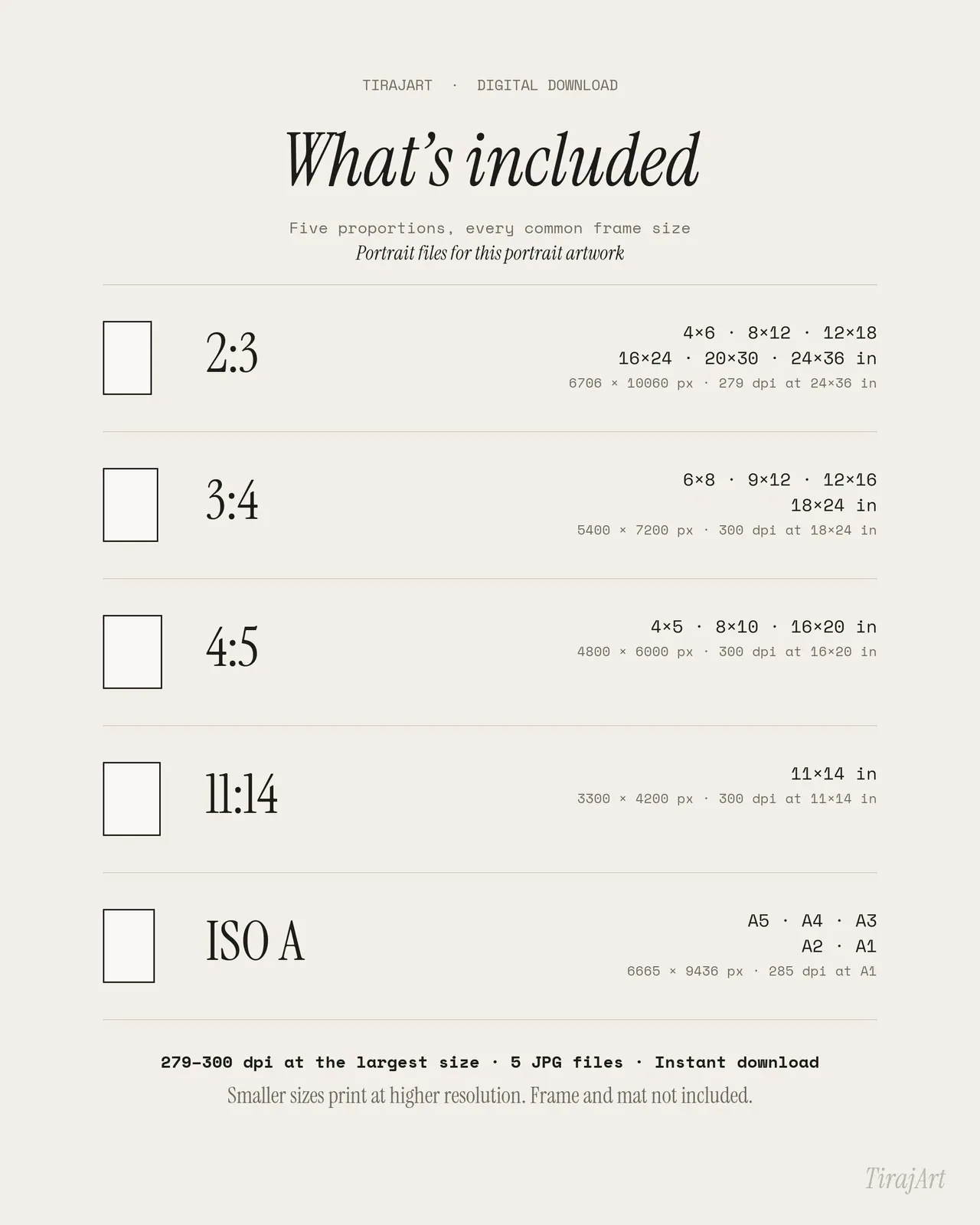
What’s included
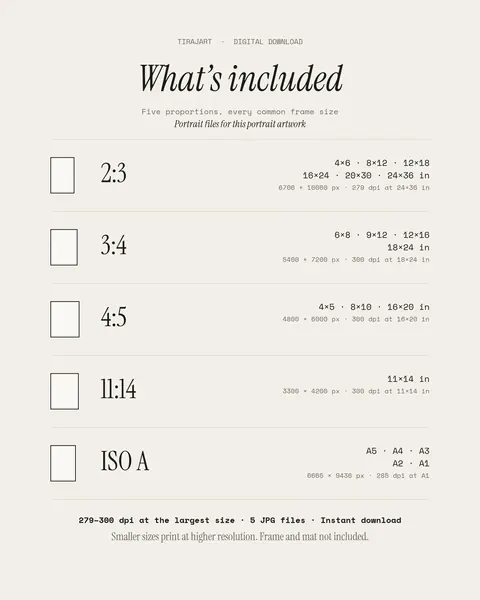
5 high-resolution JPEG files (sRGB), one per proportion:
| Ratio | Print sizes | Pixels | Resolution |
|---|
| 2:3 | 4×6, 8×12, 12×18, 16×24, 20×30, 24×36 in | 6706×10060 px | 279 dpi at 24×36 |
|---|
| 3:4 | 6×8, 9×12, 12×16, 18×24 in | 5400×7200 px | 300 dpi at 18×24 |
|---|
| 4:5 | 4×5, 8×10, 16×20 in | 4800×6000 px | 300 dpi at 16×20 |
|---|
| 11:14 | 11×14 in | 3300×4200 px | 300 dpi at 11×14 |
|---|
| ISO A | A5, A4, A3, A2, A1 | 6665×9436 px | 285 dpi at A1 |
|---|
To keep each download under 20 MB, the 2:3 file is 279 dpi at 24×36 in; the ISO A file is 285 dpi at A1 and 300 dpi or more at the smaller sizes. The other files are 300 dpi at their largest size.
The 4:5 file keeps the whole picture with a paper margin, because cropping would cut into the subject; the other files are cropped slightly to fill the sheet.
Two versions included: with paper border, and borderless (edge-to-edge).
Borderless files
The picture area only, cropped from the same print, with no paper border. Proportions where the crop would cut into the picture, or where the file would be under 200 dpi at the largest size, are left out.
| Ratio | Print sizes | Pixels | Resolution |
|---|
| 2:3 | 4×6, 8×12, 12×18, 16×24, 20×30, 24×36 in | 6006×9009 px | 250 dpi at 24×36 |
|---|
| 3:4 | 6×8, 9×12, 12×16, 18×24 in | 5400×7200 px | 300 dpi at 18×24 |
|---|
| 4:5 | 4×5, 8×10, 16×20 in | 4800×6000 px | 300 dpi at 16×20 |
|---|
| 11:14 | 11×14 in | 3300×4200 px | 300 dpi at 11×14 |
|---|
| ISO A | A5, A4, A3, A2, A1 | 6370×9009 px | 272 dpi at A1 |
|---|
| Own proportion (1:1.37) | up to 32×45 in | 6599×9009 px | 200 dpi at 32×45 |
|---|
Printing tips
Use heavyweight white matte paper (200 gsm or more, archival matte or cotton rag). Print at 100% / actual size, not 'fit to page', and pick the file that matches your frame.
Colours can vary slightly between screens and printers.
How to print digital wall art
License
The original is in the public domain (verified with the museum’s API on 2026-11-12). The Tiraj interpretation is ours: the files are for personal use only. Print them for your own home or as a gift; please don’t resell, share or redistribute the files or sell prints made from them. Full license.
Digital download: nothing is shipped, frame not included. Colours vary slightly between screens and printers.