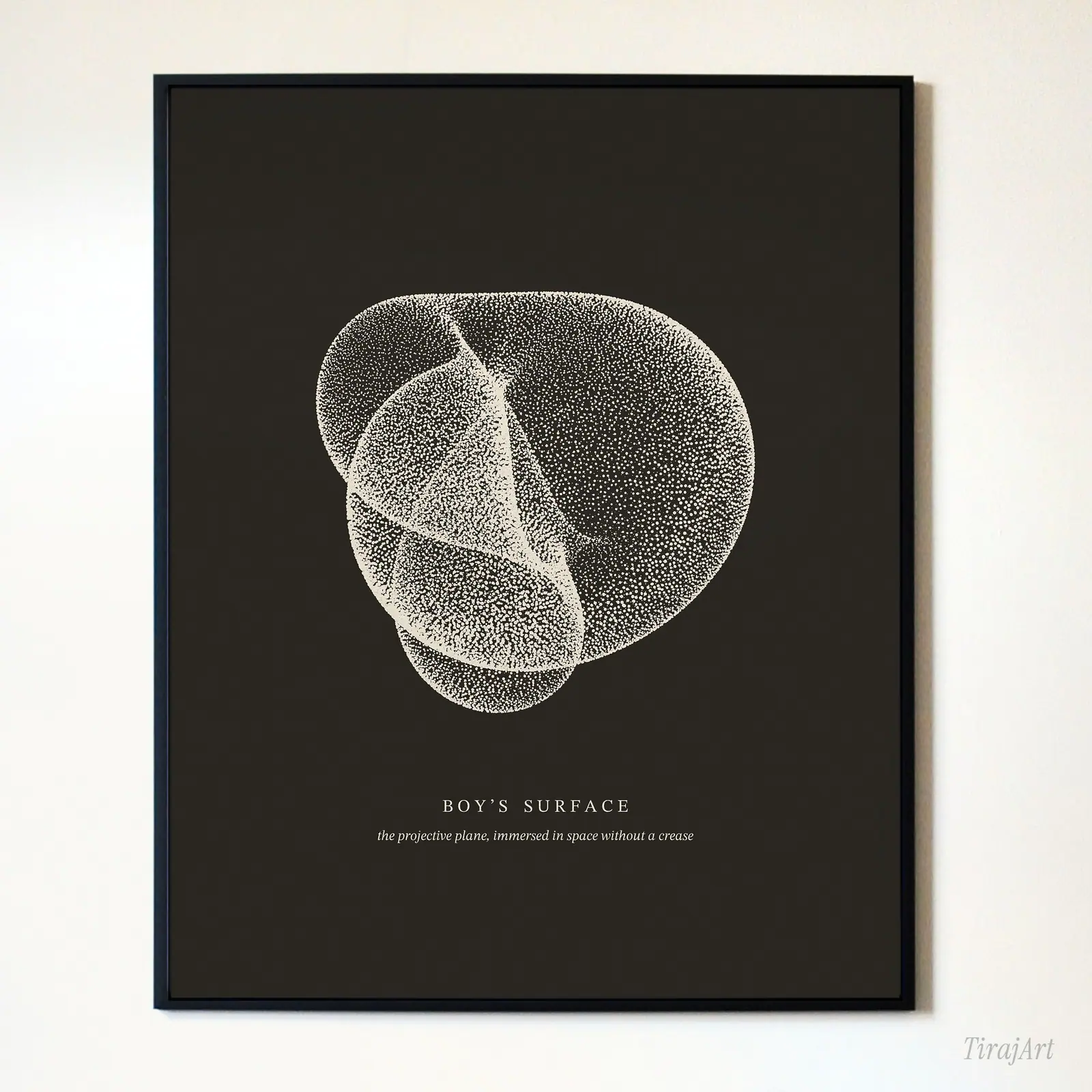
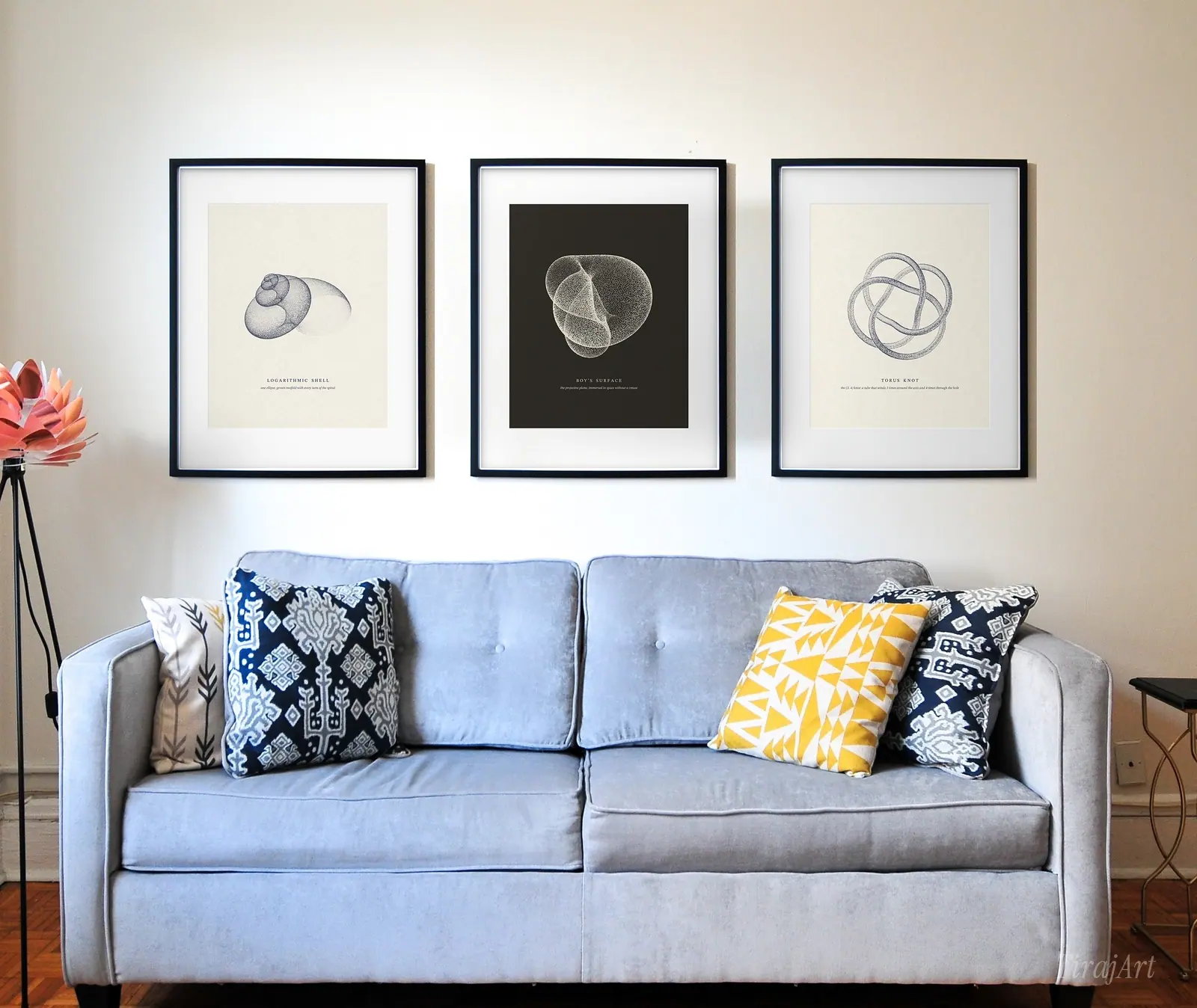
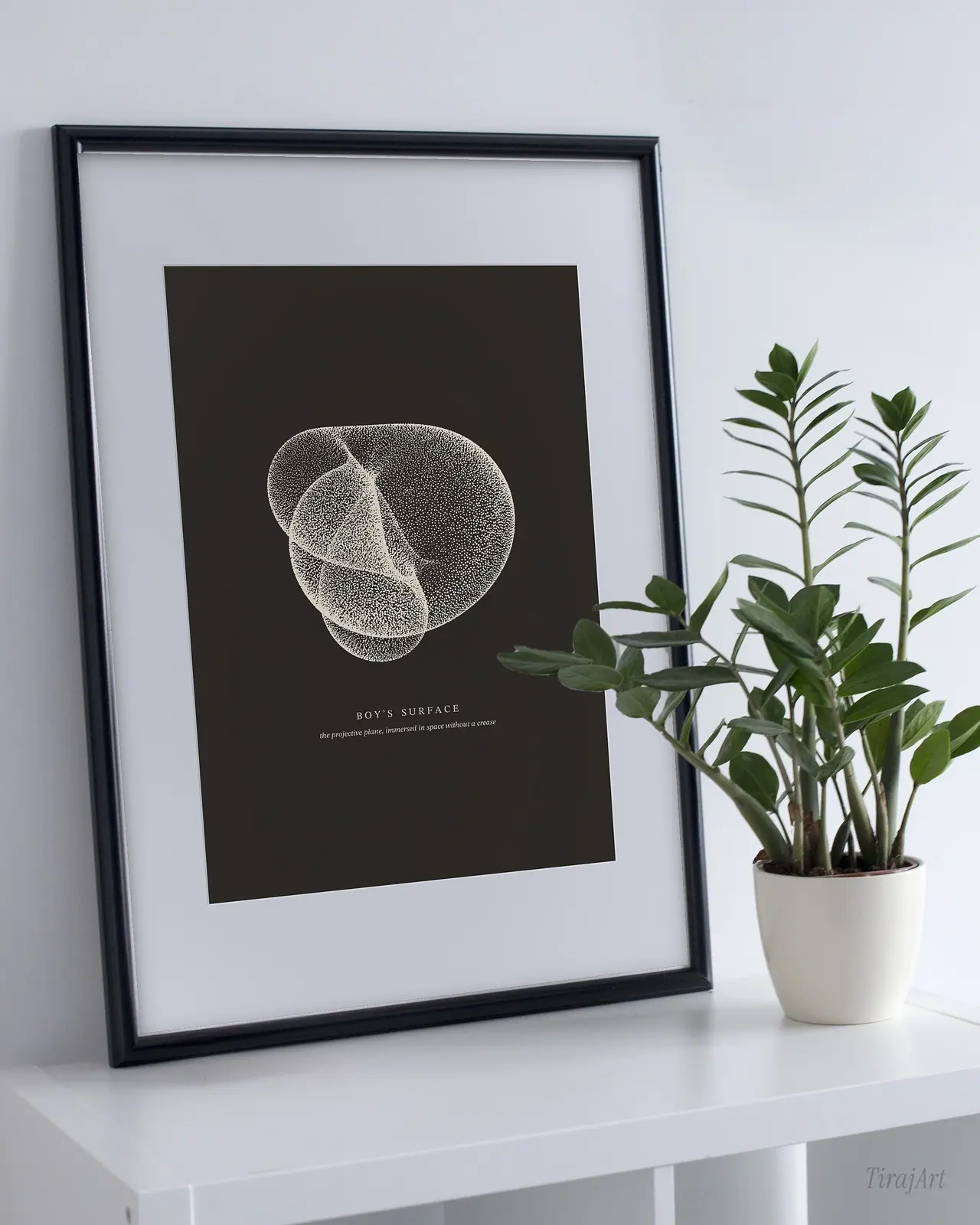
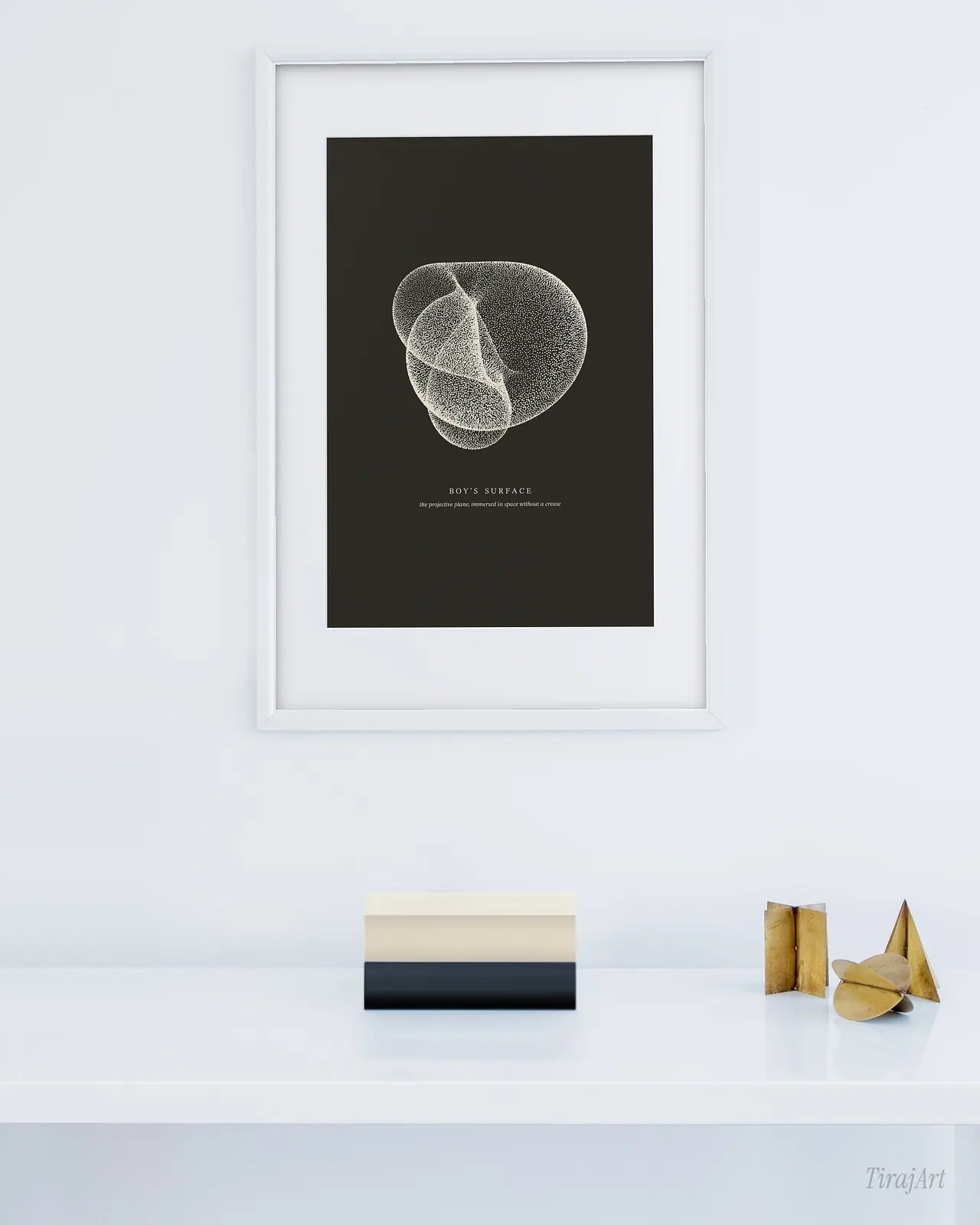
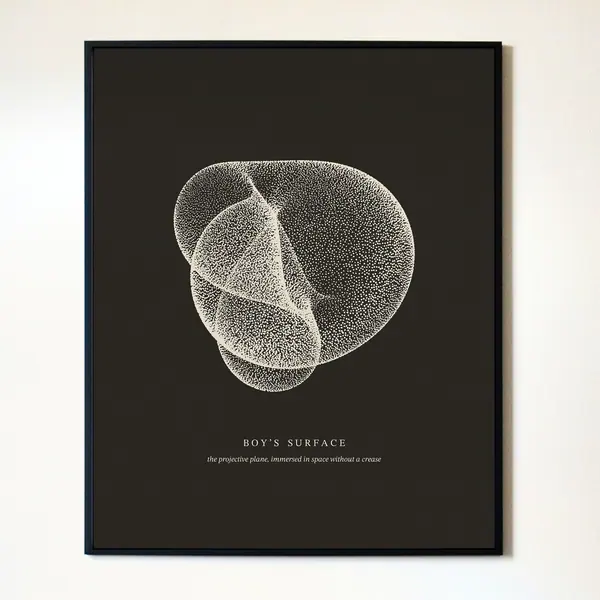
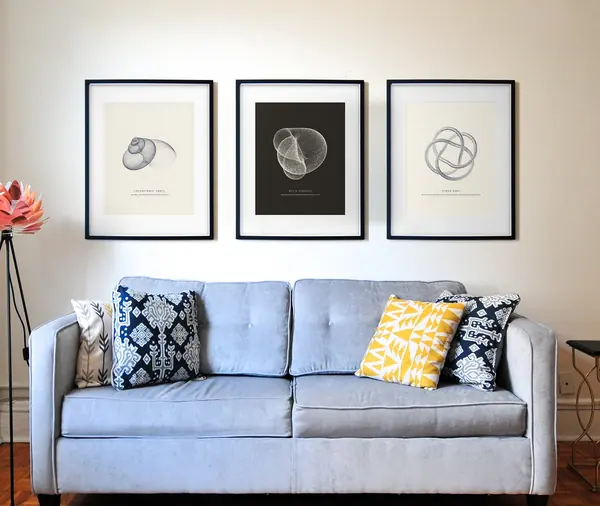
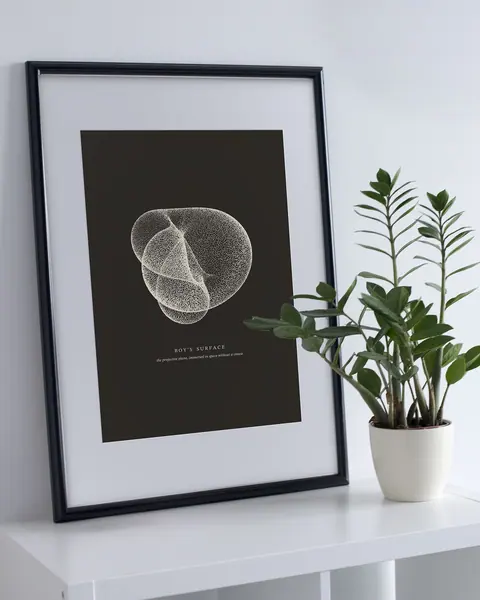
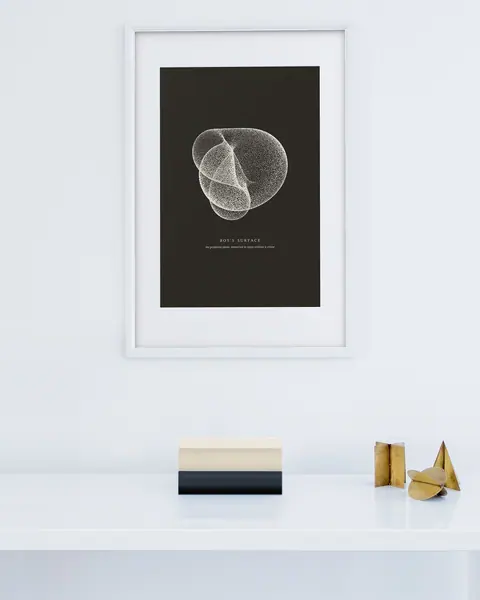
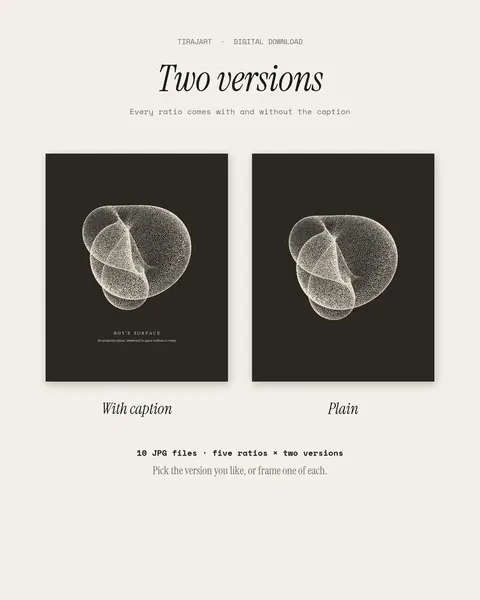
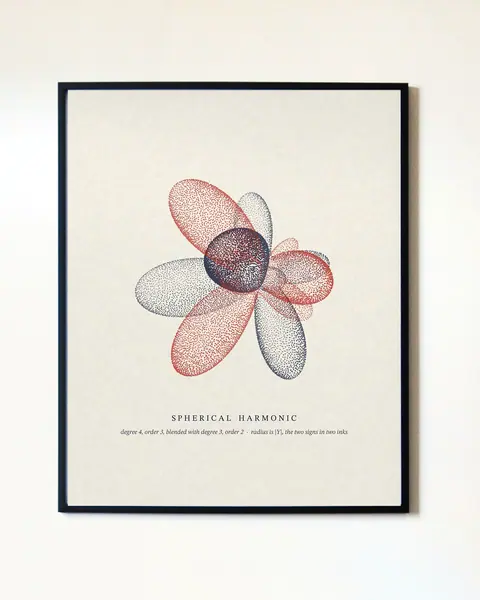
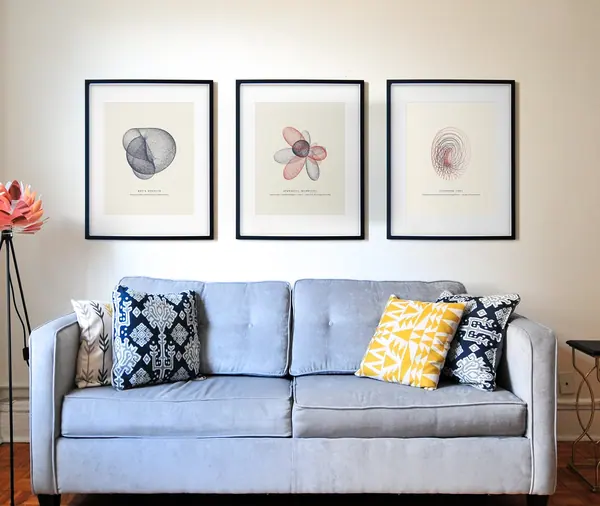
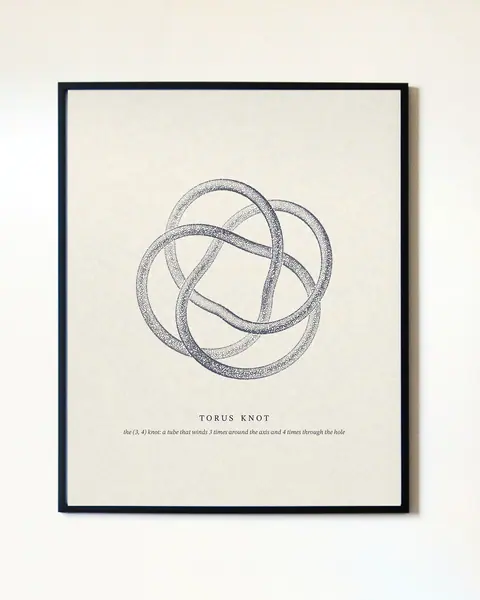
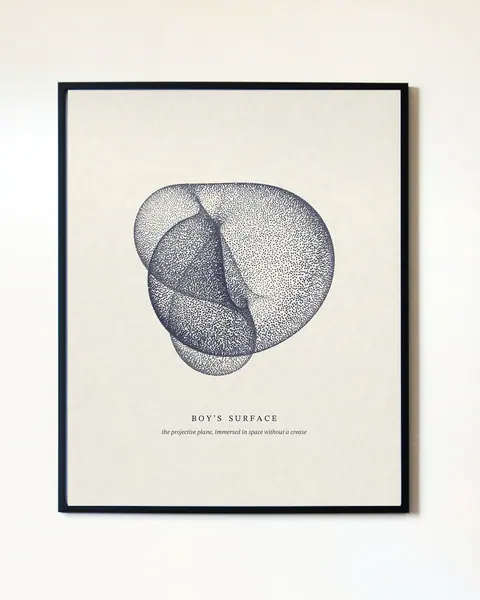
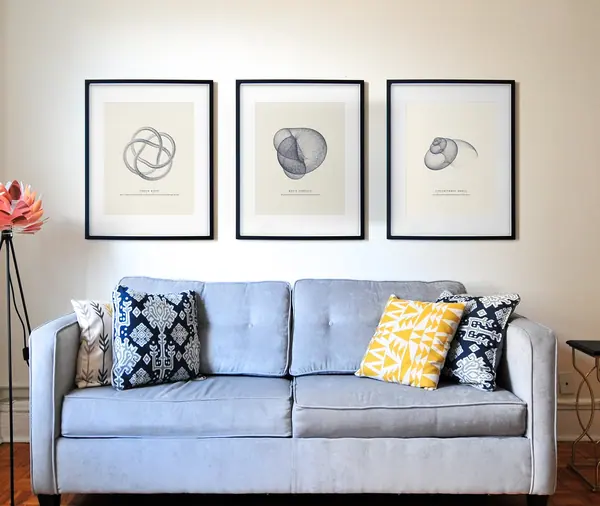
Boy’s surface, the one-sided projective plane folded into space without a crease, as cream dots on a warm near-black sheet: the negative of our dotted drawing, printed with Tiraj.
The mathematics
The projective plane is a closed surface with only one side, like a Möbius band whose edge has been sewn shut. It cannot sit in our space without passing through itself. In 1901 David Hilbert asked his student Werner Boy to prove that it could not even be folded into space smoothly, without pinches or creases; Boy found the opposite, and drew the surface that now carries his name. It crosses itself along a single looping curve that meets itself at one triple point, and it has a threefold rotational symmetry. The form drawn here uses the equations Robert Bryant and Rob Kusner found in the 1980s. A large steel model of it stands outside the mathematics institute at Oberwolfach in Germany.
The print
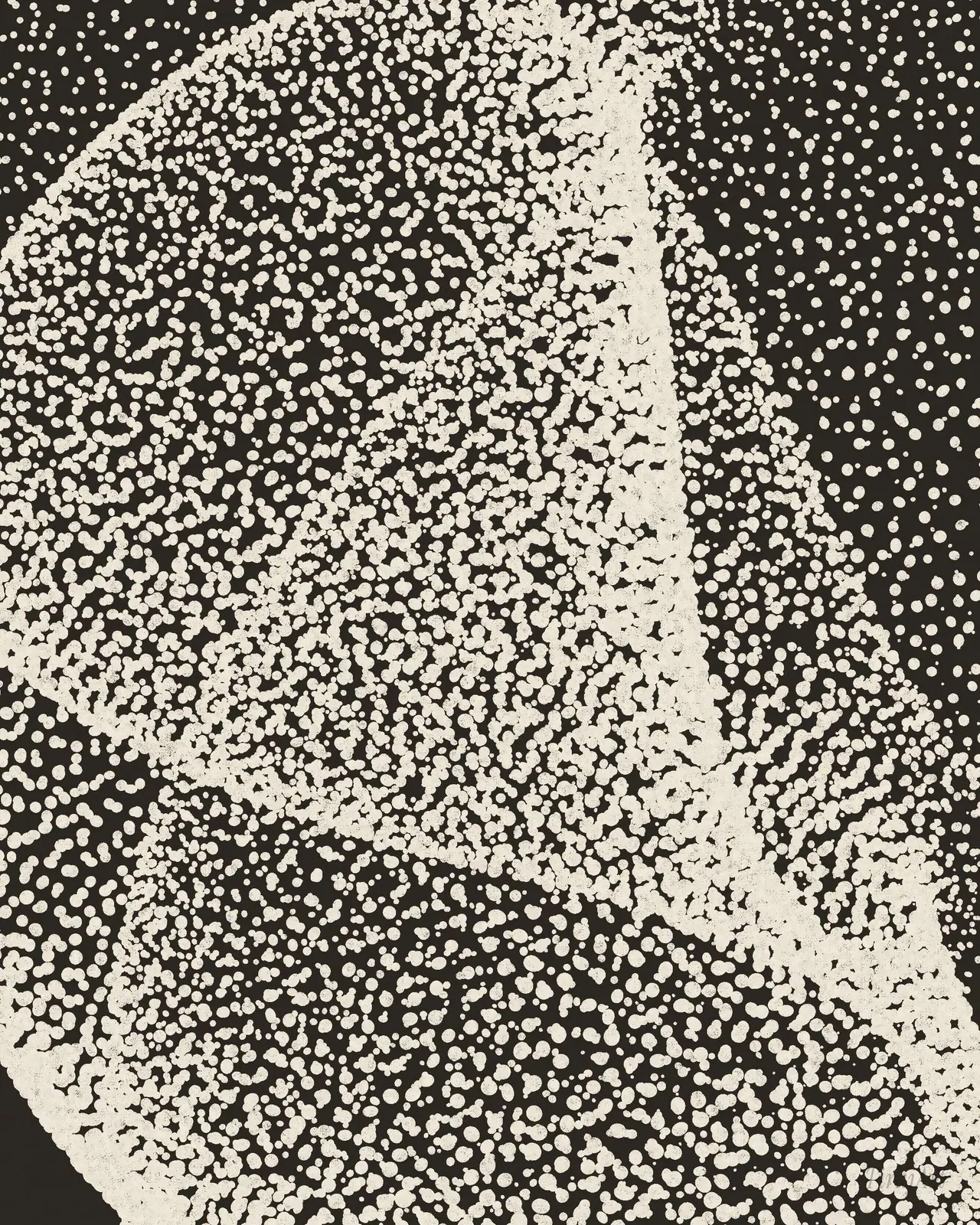
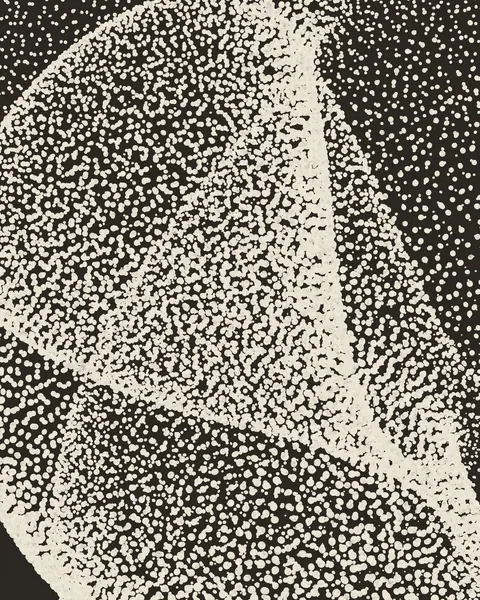
The dots are drawn first, then the sheet is reversed, so every dot is cream on a warm, flat near-black; here depth is carried by the size of the dots alone. The sheet is then printed with Tiraj, which leaves a fine speckled grain inside every dot. The black is even and quiet, so the form seems to float in the dark.
The black sheet is part of the artwork. Print on matte paper with a printer that handles large dark areas well, or use a print shop. The black ground and the grained dots are printed into the file.
What’s included
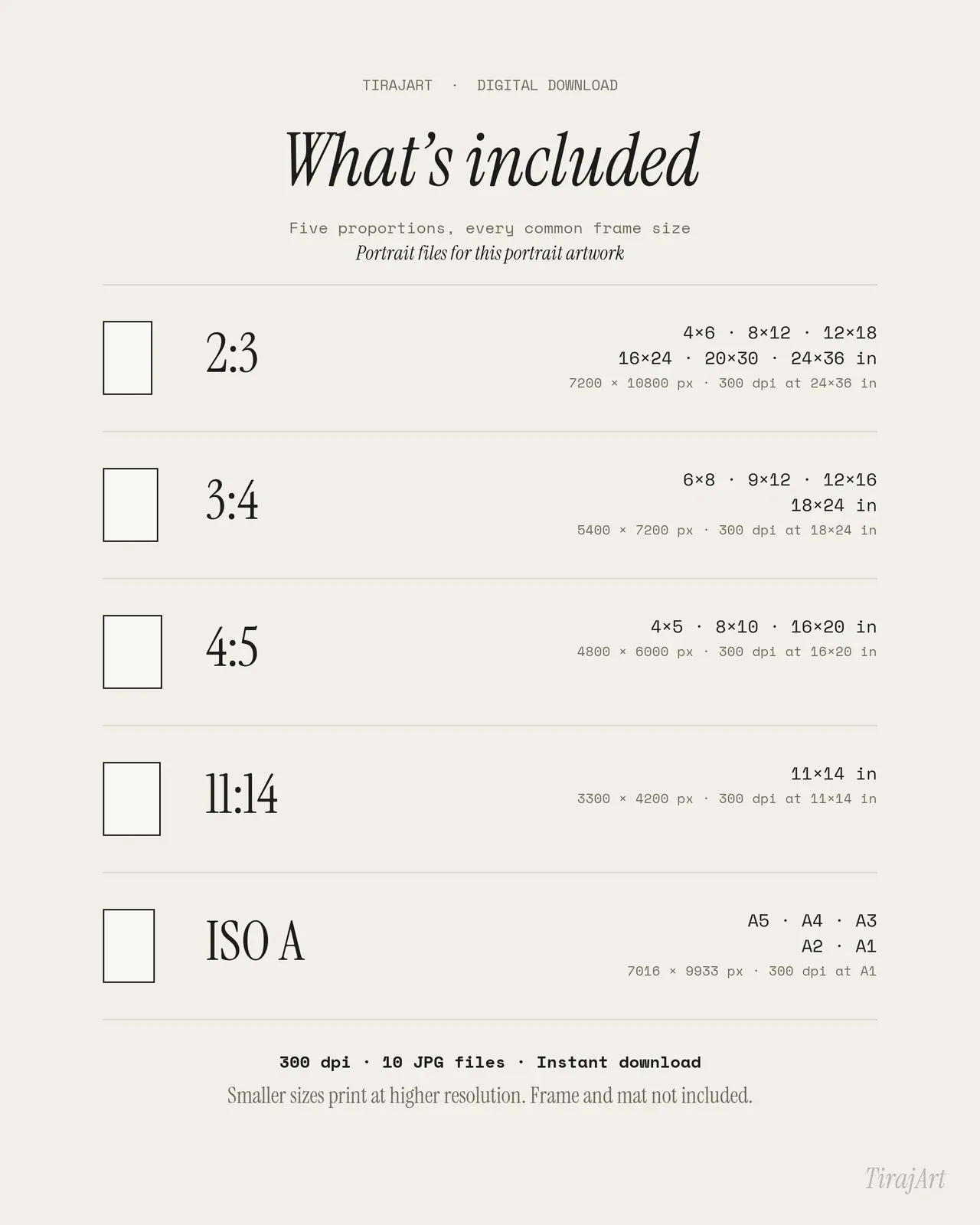
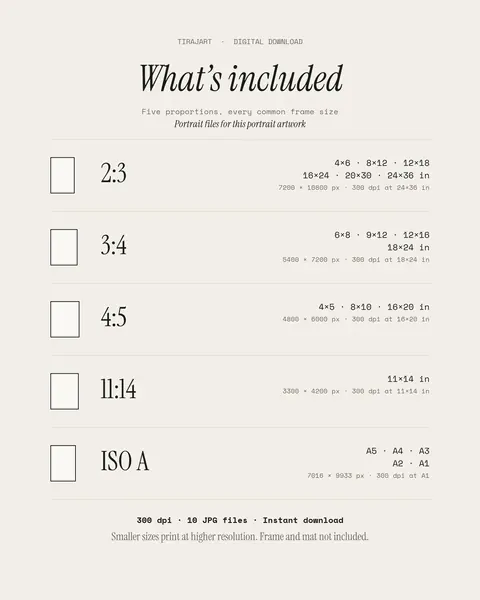
10 high-resolution JPEG files (sRGB), two per proportion:
| Ratio | Print sizes | Pixels | Resolution |
|---|
| 2:3 | 4×6, 8×12, 12×18, 16×24, 20×30, 24×36 in | 7200×10800 px | 300 dpi at 24×36 |
|---|
| 3:4 | 6×8, 9×12, 12×16, 18×24 in | 5400×7200 px | 300 dpi at 18×24 |
|---|
| 4:5 | 4×5, 8×10, 16×20 in | 4800×6000 px | 300 dpi at 16×20 |
|---|
| 11:14 | 11×14 in | 3300×4200 px | 300 dpi at 11×14 |
|---|
| ISO A | A5, A4, A3, A2, A1 | 7016×9933 px | 300 dpi at A1 |
|---|
All files are 300 dpi at their largest size.
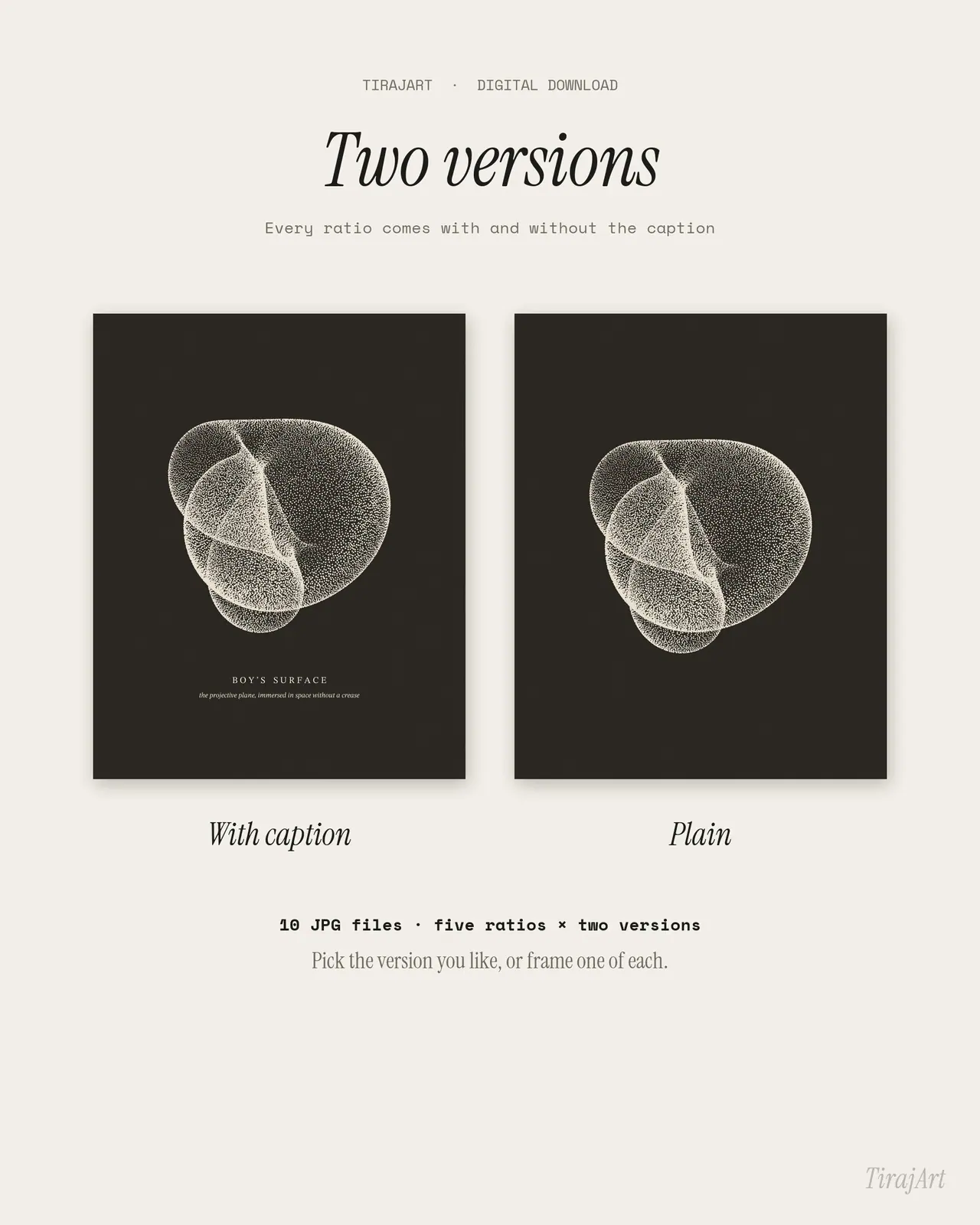
Each proportion comes twice: with the small caption under the artwork, and plain.
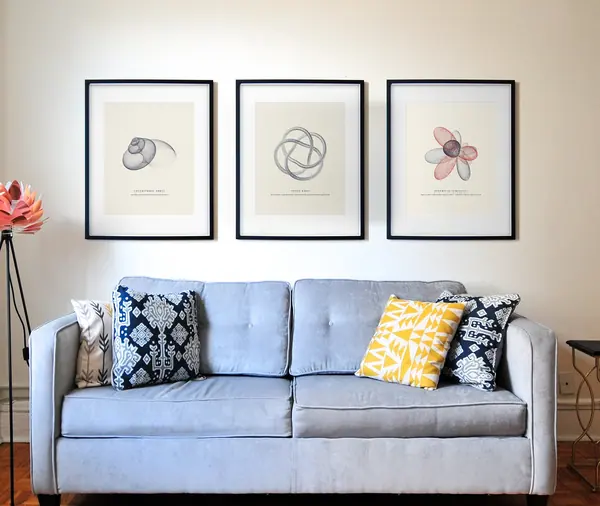
The artwork sits in the middle of the sheet with a wide paper margin, so the files frame well as they are.
Printing tips
Use heavyweight white matte paper (200 gsm or more, archival matte or cotton rag). Print at 100% / actual size, not 'fit to page', and pick the file that matches your frame.
Colours can vary slightly between screens and printers.
How to print digital wall art
License
This is an original TirajArt work. The files are for personal use only. Print them for your own home or as a gift; please don’t resell, share or redistribute the files or sell prints made from them. Full license.
Digital download: nothing is shipped, frame not included. Colours vary slightly between screens and printers.